GroundBreakers FAQs
Underground infrastructure can be complicated. Knowing what service you need should not be.
GroundBreakers provides hydrovac excavation, private utility locating, Subsurface Utility Engineering field services, CCTV line inspection, line jetting, GPS mapping, and related underground utility services throughout Indiana, Illinois, Kentucky, and Ohio.
Whether you need to expose a utility before excavation, determine what is buried beneath a project site, investigate a pipe, clear a blocked line, or collect reliable subsurface information for engineering and design, our team can help you determine the right approach.
GroundBreakers is a full-service underground utility partner providing hydrovac excavation, private utility locating, Subsurface Utility Engineering field services, CCTV line inspection, line jetting, GPS mapping, and related services.
Our teams support construction companies, utilities, engineering firms, municipalities, telecommunications providers, government agencies, environmental projects, and other organizations that need accurate information and safe access to underground infrastructure.
Start with the problem you are trying to solve.
If you need to physically expose an underground utility: Hydrovac excavation may be the right solution.
If you need to determine what utilities are present before digging: Private utility locating may be appropriate.
If an engineering or infrastructure project requires documented horizontal or vertical utility information: Subsurface Utility Engineering field services may be needed.
If you need to see what is happening inside a sanitary or stormwater pipe: CCTV line inspection can provide a real-time visual assessment.
If a pipe or storm drain has buildup, slow flow, or a blockage: Line jetting may help clean the line.
Not sure? Contact GroundBreakers with your project information and our team can help determine the best next step.
GroundBreakers works across a range of industries where underground infrastructure, safe excavation, and reliable utility information matter, including:
Yes. GroundBreakers offers 24/7 dispatch for customers throughout its service area.
For urgent needs, use the Emergency Request option or call the appropriate GroundBreakers dispatch number for your location.
Yes. One advantage of working with GroundBreakers is access to multiple underground utility services through one team.
For example, a project may begin with private utility locating or SUE fieldwork, use hydrovac excavation to expose critical utilities, and use CCTV inspection or line jetting to investigate or maintain underground piping.
Combining complementary services can help teams coordinate fieldwork and gather a more complete understanding of site conditions.
Hydrovac excavation is a non-destructive excavation method that uses pressurized water to loosen soil and a powerful vacuum system to remove the resulting soil, water, and debris.
Because the excavation can be performed with greater precision than many traditional mechanical methods, hydrovac is frequently used around underground utilities and in areas where limiting ground disturbance is important.
A hydrovac system directs pressurized water into the ground to break apart soil. A vacuum hose then removes the loosened material and transfers it into a debris tank.
This allows an operator to excavate a targeted area without relying exclusively on mechanical digging equipment such as backhoes or excavators.
Hydrovac allows crews to expose underground infrastructure with a high degree of control while reducing reliance on mechanical excavation immediately around the utility.
This makes it particularly useful for daylighting utilities, confirming utility locations, creating test holes, and performing excavation where precision is critical.
Hydrovac is widely used as a non-destructive excavation method because it can reduce the risk associated with mechanical excavation around buried infrastructure.
No excavation method eliminates all risk. Safe work still depends on proper planning, locating, trained operators, appropriate equipment, jobsite controls, and compliance with applicable requirements.
Daylighting is the process of exposing a buried utility so its actual position can be visually confirmed.
A hydrovac can create a targeted opening that allows crews to identify the utility's location, depth, size, or other characteristics before construction or additional excavation begins.
Daylighting is also commonly referred to as potholing.
Potholing is a targeted excavation used to expose and verify an underground utility.
The terms potholing and daylighting are often used interchangeably. Hydrovac excavation is commonly used for potholing because it provides controlled access to the utility while minimizing the size of the excavation area.
Slot trenching creates a narrow excavation rather than opening a much larger area of ground.
It may be used for installing or investigating utilities, piping, conduit, or other underground infrastructure where a narrow and controlled excavation is preferred.
GroundBreakers hydrovac teams support applications including:
The appropriate excavation method depends on the project, utility conditions, access, soil, and other site-specific factors.
Hydrovac can be particularly useful on congested jobsites or in locations where minimizing the excavation footprint is important.
GroundBreakers also provides remote hydrovac services for projects where the truck cannot be positioned immediately beside the excavation.
Project-specific access requirements should be reviewed with the GroundBreakers team when scheduling service.
No excavation technique can responsibly guarantee that utility damage is impossible.
Hydrovac is used to reduce excavation risk by replacing aggressive mechanical digging around sensitive underground infrastructure with a more controlled excavation process.
Accurate locating, safe work practices, qualified operators, and appropriate project planning remain essential.
Yes. Emergency response is one of GroundBreakers' hydrovac applications, and GroundBreakers maintains 24/7 dispatch throughout its service area.
For an urgent project, submit an Emergency Request or contact dispatch directly.
The achievable depth depends on factors such as soil conditions, excavation dimensions, equipment configuration, access, project requirements, and site conditions.
Rather than applying one depth limit to every project, GroundBreakers evaluates the specific requirements of the job before determining the appropriate equipment and approach.
Hydrovac work can often be performed in cold-weather conditions, but project feasibility depends on temperature, frozen ground conditions, equipment, site access, and specific project requirements.
Contact GroundBreakers with the location and project conditions so the operations team can evaluate the job.
Private utility locating identifies underground infrastructure that may not be identified through the public utility locating process.
GroundBreakers uses technologies including electromagnetic locating equipment, ground-penetrating radar, induction equipment, and other field methods to investigate underground infrastructure before excavation or construction.
811 and private utility locating perform different functions.
The 811 process notifies participating utility owners so facilities within their responsibility can be marked. However, many underground facilities located on private property may fall outside the responsibility of the public utility owner.
Private utility locating is used to investigate infrastructure that may not be covered by the public locating process.
Calling 811 is still an important step where required. Private locating complements that process rather than replacing it.
Yes. Over 65% of all buried utilities are privately owned and not covered by the 811 one-call system.
Calling 811 does not necessarily mean every underground facility on a property has been located. Privately owned electrical lines, irrigation systems, site lighting, private water or sewer infrastructure, and other facilities may require additional investigation.
If you are uncertain about what infrastructure may exist within the excavation area, a private utility locate can help provide a more complete picture.
Depending on the site and utility characteristics, private locating may be used to investigate infrastructure such as:
The ability to detect a specific facility depends on factors including material, depth, soil conditions, access, utility configuration, and the locating technology used.
Electromagnetic locating uses an electromagnetic signal to help detect and trace conductive underground utilities.
It is commonly used for metallic utilities or utilities that contain a conductive tracer wire or other detectable component.
Because no single locating technology is appropriate for every condition, GroundBreakers may use multiple methods during an investigation.
Ground-penetrating radar, commonly called GPR, sends electromagnetic energy into the ground and analyzes reflected signals to identify subsurface features and anomalies.
GPR can be useful when investigating utilities or underground objects that cannot be effectively traced using conventional electromagnetic locating methods.
No.
GPR is a powerful investigation tool, but its effectiveness can be affected by soil composition, moisture, depth, utility material, congestion, surface conditions, and other site factors.
Professional private utility locating may involve combining GPR with electromagnetic locating, existing records, visual site observations, hydrovac verification, and other methods.
A credible locating program recognizes the limitations of each technology rather than relying on a single tool.
GroundBreakers uses ground-penetrating radar and other locating technologies that can assist with investigating non-metallic infrastructure.
Whether a particular pipe or facility can be detected depends on its material, depth, surrounding soil, size, site conditions, and other variables.
Concrete scanning uses specialized equipment to investigate what may be embedded within or beneath concrete before cutting, drilling, coring, or other work occurs.
Depending on site conditions and project needs, scanning may help identify reinforcing steel, conduit, piping, or other embedded features.
GroundBreakers' private locating services can include field markings along with a report containing maps and recommendations.
The exact deliverable should be established based on the scope of the project and the level of information the customer requires.
Accuracy depends on the locating method, utility characteristics, soil and surface conditions, available records, congestion, access, and other project-specific factors.
GroundBreakers integrates high-accuracy GPS mapping into private utility locating services to collect precise geographical coordinates for identified underground utilities.
These field data deliverables provide high-quality, actionable maps and digital files that can be directly imported into CAD, GIS, or project planning software, giving project managers and engineers reliable long-term documentation of site infrastructure.
When greater certainty is required, additional investigation or physical verification through hydrovac excavation may be appropriate.
That is why GroundBreakers offers both utility locating and hydrovac services.
Private locating may be valuable for:
Subsurface Utility Engineering, or SUE, is a structured process used to collect and manage information about underground utilities for planning, design, engineering, and construction projects.
SUE helps project teams better understand utility locations before construction begins, reducing uncertainty and helping engineers identify potential conflicts earlier in the project lifecycle.
Unknown or inaccurately documented utilities can create safety risks, redesigns, construction delays, utility relocations, change orders, claims, and additional costs.
SUE provides progressively more reliable information about underground infrastructure so project teams can make better planning and design decisions.
Subsurface Utility Engineering commonly organizes utility information into four Quality Levels:
Quality Level D (QL-D): Information based primarily on existing utility records and verbal information.
Quality Level C (QL-C): Information developed by correlating records with visible surface features such as manholes, valve covers, and other utility appurtenances.
Quality Level B (QL-B): Utility information developed through surface geophysical methods to designate the horizontal position of underground utilities.
Quality Level A (QL-A): Utility information obtained through physical exposure, typically using vacuum excavation or test holes, to establish specific utility characteristics at a particular location.
GroundBreakers provides SUE field services when partnering with Engineering Firms, and has particular capabilities supporting QL-A and QL-B investigations.
The primary difference is physical verification.
QL-B uses geophysical locating technologies such as electromagnetic locating and GPR to designate the horizontal position of underground utilities without exposing them.
QL-A physically exposes the utility at a specific point, allowing project teams to obtain detailed information such as depth and other observable utility characteristics.
QL-A provides a higher level of certainty at the test-hole location.
Horizontal utility designating identifies and marks the horizontal position of underground utilities using appropriate geophysical locating technologies.
In SUE terminology, this work is generally associated with Quality Level B.
Vertical utility locating establishes physical information about a utility at a specific location by exposing it, often using non-destructive vacuum excavation.
This type of test-hole information is generally associated with Quality Level A.
QL-A may be appropriate when precise utility information is needed at critical locations, such as:
The project's engineer should determine the appropriate quality level based on design needs and risk.
GPS utility mapping records the geographic position of located or investigated utilities so field information can be incorporated into project documentation and digital mapping workflows.
GroundBreakers uses GPS mapping as part of its utility investigation and SUE field services.
Yes.
GroundBreakers partners with engineering firms that need field data to support design, utility coordination, conflict analysis, and project planning.
The goal is to provide reliable field information that engineering teams can incorporate into their broader project deliverables.
CCTV line inspection uses specialized camera equipment to visually inspect the interior of underground piping.
GroundBreakers uses robotic HD camera technology to inspect sanitary and stormwater infrastructure and identify conditions that may require maintenance, cleaning, repair, or additional investigation.
A camera system is introduced into the pipe and navigated through the line while the GroundBreakers team monitors the video from above ground.
This provides a real-time view inside the pipe without requiring excavation simply to determine what may be happening below the surface.
CCTV inspection may help identify conditions including:
Often, no.
One of the major advantages of CCTV inspection is the ability to visually investigate accessible underground piping without excavating the entire line.
If the inspection identifies a specific problem requiring excavation or repair, the CCTV information can help the project team focus its next steps.
CCTV inspection can be useful both proactively and diagnostically.
Common situations include:
CCTV allows technicians to identify and document visible conditions inside a line and focus on areas requiring closer investigation.
The exact location information available depends on the camera system, project setup, access, and inspection scope.
Sometimes.
Heavy debris, grease, sludge, or other buildup can obscure the camera's view. In those situations, line jetting may be recommended before or in conjunction with CCTV inspection.
GroundBreakers provides both services, allowing the team to coordinate cleaning and inspection when the project requires it.
Line jetting uses high-pressure water to clean underground piping by removing debris, buildup, and certain types of blockages.
GroundBreakers provides line jetting for sewer lines, storm drains, and commercial, industrial, and municipal piping.
A specialized jetting nozzle directs high-pressure water through the pipe.
The water helps break up and move debris and buildup so the line can be cleaned without relying on harsh chemical cleaners.
Line jetting may be appropriate for:
Possible warning signs include:
A CCTV inspection may be recommended when the cause or condition of the problem is unclear.
GroundBreakers' line jetting process uses high-pressure water rather than harsh chemical cleaners or solvents.
This allows lines to be cleaned mechanically with water while avoiding the need to introduce chemical drain-cleaning agents into the system.
GroundBreakers uses line jetting on a variety of piping materials, including PVC, metal, and clay.
Whether jetting is appropriate for a particular line depends on the pipe's condition, material, diameter, access, and the nature of the blockage or buildup.
No.
Line jetting can be used for both corrective maintenance and preventative maintenance.
Routine cleaning can help manage recurring buildup and may also prepare a pipe for inspection or planned repair work.
Yes.
The services complement one another well.
CCTV can help identify what is happening inside a pipe. Jetting can clean debris or buildup. A follow-up CCTV inspection can then provide a clearer look at the condition of the cleaned line when appropriate.
Use the Request an Estimate form on the GroundBreakers website or contact the appropriate dispatch team directly.
Providing detailed project information helps the team evaluate the service and equipment requirements more efficiently.
When possible, provide:
If you are not sure which service you need, describe the problem or project objective and the GroundBreakers team can help determine the appropriate next step.
Hydrovac project cost can vary based on project conditions and service requirements.
Factors may include:
GroundBreakers evaluates the scope before determining the appropriate pricing for the project.
GroundBreakers currently promotes an all-inclusive hydrovac pricing approach without separate fuel surcharges or surprise add-on charges.
Project pricing and scope should still be confirmed when requesting an estimate.
Scheduling requirements vary based on service type, project location, crew availability, equipment requirements, and project complexity.
For planned work, contacting GroundBreakers as early as possible helps the operations team coordinate resources.
For urgent situations, GroundBreakers offers 24/7 dispatch.
Use GroundBreakers' Emergency Request option or contact dispatch directly.
Indiana, Illinois & Kentucky: 317-691-1374
Ohio: 937-680-0841
When calling, be prepared to provide the project location, nature of the emergency, site contact information, service needed if known, and any immediate safety concerns.
GroundBreakers emphasizes trained personnel, properly maintained equipment, jobsite performance, and safety controls throughout its operations.
The company invests in experienced operators and laborers as well as equipment maintenance and compliance to support safe and reliable field operations.
Yes.
GroundBreakers identifies itself as 100% veteran- and woman-owned.
President and Owner Andrea Sloan is a U.S. Army Reserve veteran, and the company maintains multiple certifications related to veteran-, woman-, and disadvantaged-business ownership.
GroundBreakers lists state and national certifications that include programs associated with:
Certification requirements and status can change, so customers pursuing a certified supplier or subcontracting requirement should review GroundBreakers' current certification documentation.
GroundBreakers maintains multiple business certifications across its operating markets and nationally.
Organizations with specific procurement, supplier-diversity, DBE, WBE, or veteran-business requirements should contact GroundBreakers to confirm which current certification applies to the project and jurisdiction.
GroundBreakers provides service throughout:
The corporate office is located in Indianapolis, Indiana, and the company provides 24/7 dispatch across its operating region.
GroundBreakers operates a fleet of more than 45 trucks to support underground utility projects across its Midwest service area.
Fleet size and equipment availability allow GroundBreakers to support projects ranging from individual service calls to larger and more time-sensitive field operations.
GroundBreakers' fleet, service capabilities, and regional footprint allow the company to support a wide range of project sizes.
For large, phased, multi-site, or time-sensitive projects, contact the GroundBreakers operations team early so equipment, crews, locations, and scheduling requirements can be reviewed.
You do not have to diagnose the project before you call us.
If you need to know what is underground, we can help investigate it.
If you need to expose something underground, we can help excavate it.
If you need to see inside a pipe, we can help inspect it.
If you need to clear a line, we can help clean it.
If your engineering team needs better subsurface utility information, we can help gather it.
And if the situation cannot wait, GroundBreakers provides 24/7 dispatch throughout Indiana, Illinois, Kentucky, and Ohio.
As a US Army Reserve veteran and working mom of two, Andrea Sloan has been – and still is – in the trenches daily. She’s never been afraid of hard work or a challenge, making her perfectly suited to run GroundBreakers.
A born and bred Hoosier, Andrea earned her degree from Indiana University while serving in the US Army Reserves. Her hard work, discipline, and passion have established her as a visionary leader, working to guide several companies through exponential growth.
Since 2019, she’s been leading the strategic vision of GroundBreakers, guiding it to new heights with not only revenue, but expanded operations in the Midwest and new service lines, including CCTV pipe inspection, private locating and line jetting.
Andrea focuses on building a strong company culture centered around relationships and listening first. She is dedicated to revolutionizing the excavation industry through innovation and an unwavering commitment to employee safety and exceptional customer service.
Andrea is a strong advocate for veterans and females in the construction workforce. She is the 2019 recipient of the National Association of Women Business Owners (NAWBO) Emerging Entrepreneur Award, and is proud to have broken barriers in the construction industry by making real progress in advancing diversity, equity, and inclusion efforts. She also the proud recipient of the Forty Under 40 Award and is on the Indiana Construction Roundtable Diversity and Inclusion Committee.
CERTIFICATION
CERTIFICATION
CERTIFICATION
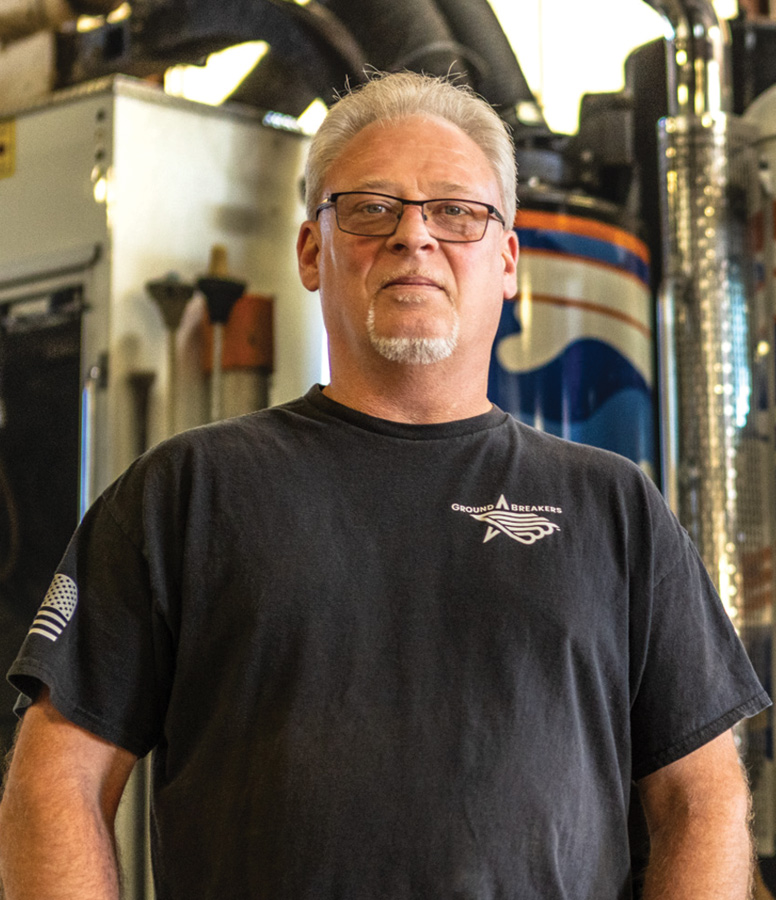
With 28 years of experience in the construction industry, Anthony Norman has excelled in various roles, including gas pipeline, civil construction, site development, building trades (both commercial and residential), hazardous cleanup and remediation. For the past 13 years, he has specialized in hydrovac excavation, contributing significantly to the expansion of GroundBreakers through his dedication and the support of the company’s strong, positive leadership team.
Anthony has consistently performed tasks with quality, precision, and professionalism, whether as part of a crew or as a crew leader. His current goal is to ensure GroundBreakers’ equipment remains safe, excellent, DOT compliant, job-ready, and reliable for both operators and clients, as the company continues to grow into a promising future.
In his free time, Anthony enjoys spending quality moments with his two sons, wife, and extended family. He also loves playing pool whenever he gets the chance.
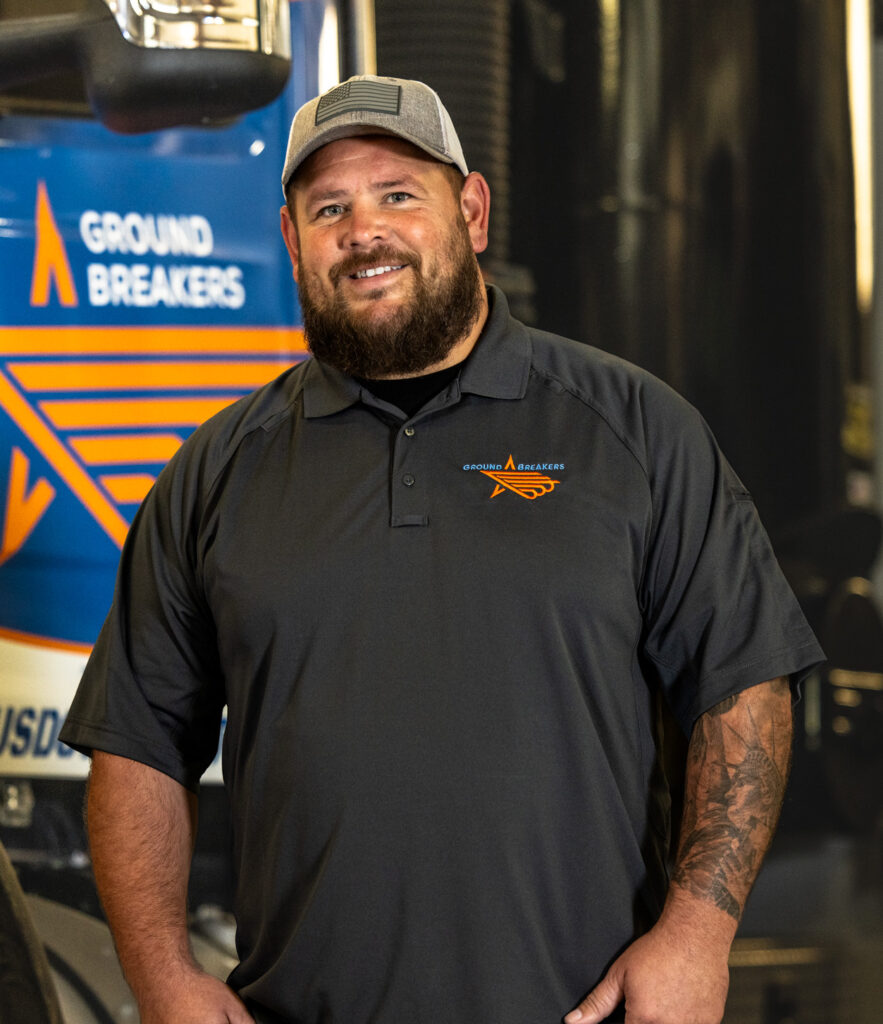
Terry Hutchison has proven himself a force to be reckoned with in the hydrovac industry, having climbed the ranks from laborer to Operations Manager at Groundbreakers. With over 13 years of experience, Terry is dedicated to ensuring that quality work and safety are always top priorities.
As a leader within the Groundbreakers team, Terry is committed to fostering strong customer relationships and continually enhancing the company’s reputation. His extensive safety training empowers him to lead the field team with confidence and precision on any job site.
Outside of work, Terry enjoys spending time outdoors with his blended family. He loves traveling, hiking, fishing, hunting, and anything with a motor. A devoted Colts fan, Terry looks forward to his annual trips to watch them play.